Wednesday, February 20, 2019

George Bayliss

The Life of George Bayliss (1868 - 1941)


By his great-great-great-grandson, Oliver Moules


George Bayliss was born in the market town of Ledbury, in the east of Herefordshire, on the 27th of April 1868. He was the seventh child of Thomas Bayliss, a 46-year-old boatman who worked on the canal, and his 41-year-old wife Mary Ann Thomas. George had four older brothers and two older sisters, as well as five half-siblings from his mother’s first marriage to William Lane, who died in 1856. George’s younger sister, Ada, was born in 1872 when George was four years old. George grew up in a small cottage next to the Hereford-Gloucester Canal, where his father worked as a boatman transporting goods and people along it on his canal boat. George’s mother died when he was eight years old, and he was raised solely by his father from then on. 

George left school around the age of 12. Immediately after leaving school, George started working as a boatman for his father. In addition to his father, George also worked alongside his older brother Samuel. They worked aboard Thomas’ canal boat, which he had named “Emma.” Their job was to transport timber and coal along the canal, which they would sail from Ledbury to Gloucester every day. 

When George was 21 years old, he decided to leave the boatman trade and instead enlist in the army. He traveled to Hereford, where he enlisted in The Royal Artillery on the 29th of August 1889. He was described as 5ft 9¾ and 154lbs, with light brown hair and grey-coloured eyes. George then traveled 50 miles to Shrewsbury for his medical examination two days later. He was deemed “physically fit” for service, and was officially approved for military service on the 2nd of September 1889. After spending three months training at the Royal Hibernian Military School in Dublin, George was posted to Singapore on the 5th of December.
George during his time in India.

At this time, Singapore was a British Crown Colony. The Colonial Government’s ineffectiveness in controlling the growing population of Singapore resulted in the society becoming lawless and chaotic. This had paved the way for several Chinese criminal “secret societies” to become extremely powerful, and wars between rival factions of these societies resulted in hundreds of deaths. The British governor, Sir Cecil Clementi Smith, had began clamping down on these societies in 1889 – so it is likely George spent his time in Singapore doing this. Smith’s plan was somewhat successful, and the secret societies were driven underground. George returned home to England on the 11th of April 1891. 

Whilst back home, George returned to his job as a labourer. A year later, he was called up again and was posted to India, arriving on the 22nd of September 1892. George spent the next five years in India. On the 28th of November 1895 he was promoted to the rank of Lance Bombardier, but on the 14th of December he was demoted back to the rank of Gunner at his own request. George returned home on the 19th of March 1897. 

Upon his return to the UK, George moved from Herefordshire to Wales. It is likely he went to Wales for work. He settled in the village of Williamstown, in the Rhondda Valley, where he found work as a coal miner. Not long after, George met Sarah Jane Walters who had lived there for several years. Four months later, on the 17th of July 1897, George and Sarah got married. George and Sarah lived at 8 Rowling Street, in Williamstown, with Sarah’s parents William and Lizzie, and her brother Thomas. 

George and Sarah’s first child, Alice Maud Bayliss, was born on the 11th of April 1898 – 16 days before George’s 30th birthday. They had a son, Trevor Thomas Bayliss, in 1899 but Trevor died at the age of 1. On the 11th of October 1899, The Second Boer War broke out in South Africa between Britain and The Boers. In January 1900 George was called up to fight in the war. George and his regiment set sail for South Africa board The Cestrian and arrived on the 10th of January 1900. As part of the “14th King’s Hussars” regiment, George fought in the Siege of Kimberley, where British forces defended the town of Kimberley from attacking Boer forces. The war ended with a British victory on the 31st of May 1902. George returned home to Williamstown on the 18th of August, where he returned to his previous job as a coal miner.

George in the military in later life - either
The Boer War or World War I.
Upon returning from the war, George and Sarah moved out of Sarah’s parents’ house and into their own house 12 doors down, at 20 Rowlings Street. Over the next few years, George and Sarah had four more children: William Henry “Bill” Bayliss in 1902 and twins Elsie Maud Bayliss and Allen George Bayliss in 1904. Allen died shortly after his birth, and Elsie died at the age of one. George’s children Maud and Bill were the only ones to survive to adulthood. George and Sarah also lived with George’s friend Alfred Brimble, who worked alongside George in the coal mine.

George was possibly involved in the infamous Tonypandy Riots of 1910. The riot started after a series of strikes by coal miners in South Wales over their wages - George may have been among the coal miners who was striking. The strike eventually turned into a riot where shops and houses of the mine owners were attacked. In response Winston Churchill, who was Home Secretary at the time, ordered the military to go and stop the strikers. Over 500 miners were injured and at least one was known to have been killed. Several strikers were sent to jail, which resulted in another protest where up to 10,000 miners marched in their support. Many in South Wales were very resentful towards Churchill for his actions against the miners - many living in South Wales still hold this grudge today. George and his family also held animosity towards Churchill for this event. A few years later, the Bayliss family moved to 16 Davies Street, in Williamstown.

On the 28th of July 1914, World War I erupted throughout Europe. He signed up to the army on the 3rd of September 1914, in Porth. He was described as 5ft 12, 148lbs and with grey eyes and brown hair. George was posted to France in January 1916 and helped man the artillery guns until October. He was recalled to Harfleur, in France, where he was deemed “physically unfit for service”, discharged and sent home. He was found to be suffering from myalgia, which is pain in the muscles caused by a combination of old age and trench fever. George returned home on the 25th of October 1916. The war ended two years later, in 1918.

Around 1920, George met Tom Franklin. Tom was also a veteran of World War I, and originally from the village of Box, in Wiltshire. Tom had come to Williamstown after the war to work in the coal mines, following his brother who had done the same thing. George and Tom worked together in the coal mines, so it is likely that it was through George that Tom met George’s daughter Maud. Tom and Maud got married on the 26th of March 1921. They had four children: Violet in 1921, Bill in 1924, Dennis in 1927 and Nancy in 1933. In the late 1930s, Tom and Maud moved their family back to Tom’s hometown of Box. George and Sarah’s son, Bill Bayliss, also went with them. George and Sarah then moved into a new house, 51 Cornwall Road. It is known that George had a close relationship with his granddaughter, Violet.

In the late 1930s, Sarah became hospitalised in Llwynypia Hospital, about 2 miles away. She died there on the 16th of October 1939, age 64. This left George a widower. He lived alone at his house in Williamstown from then on. Although by this time he was retired, George received a pension from the army for his service in the Boer War and World War I. George died in his house on the 7th of November 1941, age 73. His daughter, Maud, died three months later at the age of just 43. George was buried beside his wife in Williamstown. His son, Bill, never married or had children and lived until 1975.

George’s first great-grandchild, Christine Maud Stenner, was born in 1944, 2.5 years after George died.

Monday, January 7, 2019

Jacob Franklin

The Life of Jacob Franklin (1826 - 1915)


By his great-great-great-great-grandson, Oliver Moules


Jacob Franklin III was born on the 2nd of April 1826, in Westwells, Corsham, Wiltshire. Jacob's parents were Jacob Franklin Jr. and Elizabeth Norris. Jacob Franklin Jr was a 40-year old labourer and retired member of the Royal Navy, who may have fought in the Napoleonic Wars which had ended 13 years earlier. Jacob spent his childhood growing up in Westwells with his large family. Jacob had two older brothers: Jonathan Franklin, who was four years older, and John Franklin who was one year older. Following Jacob were five younger siblings: William in 1828, Sarah Jane in 1832, Marianne in 1834, Mark in 1839 and finally Julia in 1840.


Jacob arrested at age 15 for destroying a fence.
Jacob did not attend school and started work at an early age. From the age of around 12, he began working as a labourer alongside his father and older brothers. He may have been among the many labourers who helped construct the nearby Box Tunnel, which opened in 1841. At age 15, later in 1841, Jacob got in trouble with the law for the first of many times in his life. In December, Jacob and his childhood friend and neighbour, James Tinson, were found guilty of "willfully destroying a line fence to the garden of Thomas Jones." Jacob and James were both sentenced to one month each in prison. After being released from prison in early 1842, Jacob returned to working as a labourer.


At some point over the next few years, Jacob became engaged to Sarah Barnett. Sarah was also from Corsham, having been born at Pound Pill, and her father worked alongside Jacob as a labourer. They married on 11 November 1844, at St. Bartholomew's Church in Corsham. Jacob was 18 years old and Sarah was 17. After the wedding, Jacob and Sarah moved to Greenhill. At this time in Corsham, the completion of Box Tunnel had caused underground quarrying in the area to flourish, due to the new way to transport the cut stone and ease of access to the quarry. As a result, many local labourers - including Jacob - began working as quarrymen.

Jacob and Sarah's first son, William, was born on 16 October 1845 when Jacob was 19. Over the next few years they had several more children: George Franklin in 1849, Thomas Franklin in 1850, Ann Elizabeth Franklin who died as a baby in 1852, and another Ann Franklin in 1853. Shortly after Jacob's 27th birthday in 1853, his mother was diagnosed with Typhus fever. She died three weeks later, on 29 April 1853, when she was 54 years old. Jacob and Sarah's next daughter, Elizabeth Franklin, was born in 1856 and named in honour of Jacob's mother.

1859 was a particularly hard year for Jacob. The year started with the sudden death of his wife, Sarah. She died on 20 January 1859 of valvular heart disease, and was only 31 years old. Jacob was now a 32 year old widower with four young children. Just a few months after Sarah died, Jacob became engaged again to Sarah Neate. Sarah Neate was from Atworth, and 12 years younger than Jacob. Jacob and Sarah married in Atworth on 24 October 1859. However, just days before their wedding, Jacob was struck by another family tragedy when his younger brother, Mark, was killed in the Quarry at the age of 22.

After getting married, Jacob, Sarah, and Jacob's five children moved from Corsham to the nearby village of Box, so Jacob could work in the Box Freestone Quarry. Jacob also adopted Sarah's three year old daughter, Elizabeth Neate, who had been born out of wedlock. Jacob and Sarah had several children over the next decade: Sarah in 1862, John in 1864, Henry in 1866, Rosina in 1868, Lily in 1870 and Alice in 1872.

In 1873, Jacob suffered a sad family tragedy. On Sunday, 16 November 1873, Jacob's 9 year old son John was playing near the edge of a disused quarry at Box Hill. John lost his footing and fell 12 feet into the quarry - a large piece of the ceiling then fell onto him and crushed his arm "very badly." John's 7 year old brother, Henry, ran home to get Jacob. Upon reaching the quarry, Jacob found his son "crushed under a large mass of stone of some two tons weight." Despite this, John was still alive. Jacob managed to rescue his son and John was taken to the Royal United Hospital, in Bath. Due to his injuries, John's arm had to be amputated. Whilst in hospital John developed a fever, and he died the next evening. An inquest was held into John's sad death. It was ruled as an "accidental death", and it was found that "there was a number of disused quarries in [Box] in a dangerous condition." The jury asked the coroner to communicate with "the responsible parties" to make them safer.

In 1874, Jacob was arrested again for assaulting George Greening - the keeper of The Bear Inn, in Box. On the evening of the 31st of January 1874, Jacob came into The Bear with Sarah and one of their children, and went into the taproom. About ten minutes later, George heard a woman scream and ran into the taproom to find Jacob beating Sarah with a leather strap. As soon as George tried to stop him, Jacob reportedly said he would "serve you the same" and punched George in the face. Some of George's friends then rushed forward and threw Jacob out of the building. Jacob refused to leave and remained outside offering "to fight anyone." Jacob was fined £1 (worth about £62 in modern money). At the time, Jacob was dealing with his son's tragic death less than two months before - which could explain his behaviour here.

Jacob and Sarah had one more child in Box, Emma Franklin in 1875, before relocating to the nearby village of Colerne. Jacob took up a new job as a farm labourer on Widdenham Farm, where he worked alongside several of his sons. Jacob and Sarah's youngest child, Ellen, was born in 1879 when Jacob was 53. In 1881 Jacob was briefly put out of work after injuring himself. On 3 September 1881, Jacob tripped and fell over whilst getting over a stile at Colerne. He was taken to The Royal United Hospital, in Bath, the next morning suffering from a contused back which healed after a few weeks. It wasn't long after that Jacob and Sarah moved back to Box, and Jacob returned to his job in the Quarry. The settled on Box Hill, where Jacob's eldest son, William, lived with his family.

By this time in his life, Jacob had enough experience and skill as a quarryman to become a ganger (self-employed foreman), who employed his own team of quarrymen. In December 1882, Jacob signed a contract with R.J. Marsh and Co. to work for them for 12 months. However, by the 31st of March 1883, Jacob "gave out" and refused to complete the contract. He was summoned to court, and said his reasoning for not fulfilling the contract was that he "could not go on without help because the stone turned out bad." Jacob was made to pay £3 9s 8d to R.J. Marsh and Co, which is now worth about £230. In 1889, Jacob's son George died at the age of 40. Three of Jacob's siblings, Jonathan, John and Sarah Jane, all died in 1895. Jacob's last surviving sibling, Marianne, died in 1904 age 70.

Jacob continued to work in the Quarry well into old age. At the time of the 1901 census, Jacob was still listed as working as a "stone quarryman" despite being days away from his 75th birthday. On 26 October 1901, two days after Jacob and Sarah's 42nd Wedding Anniversary, Jacob's eldest son, William, died age 56. William's widow, Elizabeth Jane "Bessie" Franklin, later remarried to Henry John "Jack" Simpkins - whose mother was Jacob's step-daughter Elizabeth Neate.

Jacob retired at some point over the next few years. In 1905 Jacob was widowed again when Sarah died age 67. They had been married for 48 years. After Sarah died, Jacob lived alone on Box Hill.

In 1908, the 82-year old Jacob was taken to court yet again after another assault: on 25 July 1908, Jacob supposedly "assaulted" a little girl called Elsie Hancock. Elsie lived at The Quarryman's Arms pub, which was run by her family, and on 25 July Jacob went there and had a pint of beer. Elsie's mother, Sarah Hancock, left Jacob and Elsie alone in the taproom whilst she cleaned the bar. She then hear a noise which sounded like Elsie, and upon entering the taproom found Jacob "behaving improperly towards the child" with his hand over her mouth. Jacob denied the charge of assault, and during the trial seemed confused and "apparently did not know what had taken place." Investigators found that he was a respectable person. He was fined £5 and ordered to have good behaviour for 12 months. The judge also advised Jacob's family to "keep him under some restraint" due to his advanced age. Shortly afterwards Jacob moved in with his daughter Emma, and her family. He was found to be suffering from dementia, and remained in her care for the rest of his life.

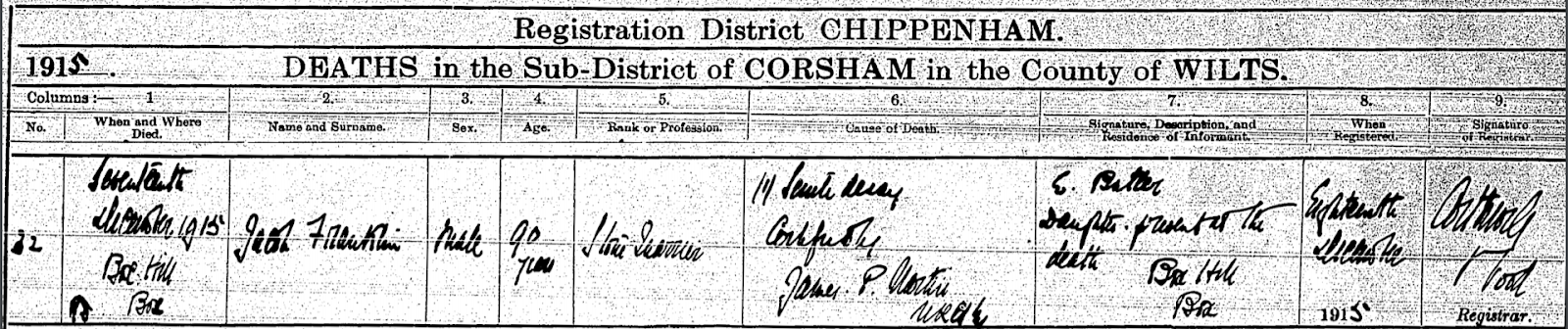
Jacob lived long enough to see the start of World War I on 28 July 1914. Several of Jacob's grandsons fought in the war: William James Franklin and Henry John Tom Franklin both served in the army, whilst Jacob James Franklin and Percy George Franklin served in the Royal Navy. On 10 December 1915, Jacob's eldest grandson, William James Franklin, died in Gallipoli of frostbite whilst fighting in the war. Exactly one week later, on 17 December 1915, Jacob died at the age of 89 of "senile decay" - what would now be described as dementia.
Jacob's death certificate

Jacob was survived by 10 of his 13 children, 46 of his 62 grandchildren and 21 great-grandchildren.